Tuesday, September 7, 2010

City Councils Save Millions Using Smartphone Apps

It's hard to believe that governments can actually save money but city councils in the UK have apparently saved taxpayers about $354 million. How? By using smartphone applications and location based services instead of more expensive alternatives. Smartphone Apps are being used to identify when the next bus will arrive and where road construction is going on. The consumer benefits enormously by avoiding congested areas and wasting time waiting for transport. Other applications include paying for your parking meter via your smarphone, reporting vandalism as it is happening, finding schools and libraries and even restaurants and pub hygiene ratings. 

Cities with public transport systems all over the world can benefit from smartphone Apps. Washington DC for example, uses the Next Bus App developed by the Washington Metropolitan Area Transit Authority.  The App uses the GPS units in the system's buses to approximate arrival times at every bus stop on every route.  Because it is in real-time, the consumer knows about delays due to traffic congestion as it's all factored into the scheduled arrival times. The App also has a drop down list of every stop to pick from, in case you are not at your destination yet. With 12,000 stops in a busy city, commuters are sure to  appreciate this App.
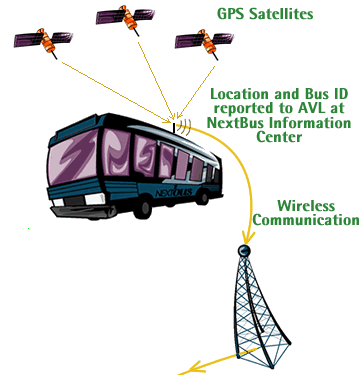
Canada is also implementing this technology. The Société de transport de Laval’s public-transit authority is the first in Quebec to use GPS technology to let commuters know whether buses are running on time.  Laval has also implemented this App in Toronto's public transport system.  

If you're a commuter without a smartphone, these Apps alone should convince you to finally take the plunge.  

Thursday, September 2, 2010

iPhone To Be Used In Upcoming U.S. Elections

The general election of 2008 saw the use of social networks and the Internet play an important part in political campaigning for the first time.  Now in 2010, with geo-location and GPS being a standard smartphone feature, we are about to see yet a new revolution in our elections take place -  on the mobile platform, with the Apple iPhone taking the lead.

The iPhone App will assist fieldworkers canvassing their neighborhoods.  Volunteers can quickly pull up data on voters combined with maps and voter contact lists.  Gone is the clipboard and paper map!

The iPhone App will also include breaking news alerts, talking points and interactive literature to share with voters right there on the their doorstep.  And it's not just one-way communication.  The volunteer can also send real-time feedback and door counts to political headquarters. This iPhone App has certainly eliminated the need to input data overnight after field workers return to base.  Now it will be live and thus permit campaign analysts to view the picture as it unfolds, back at base.  

In just two years, this is a revolution in technology that will change the political campaigning landscape in ways we could not have imagined back in the 2004 elections.  In the 2008 elections, it was all about YouTube and Twitter most notably utilized by the Obama campaign, and then came Facebook.  In 2010, we now have sophisticated smartphones that bring the technology on the road with all the possibilities of live, geo-specific analysis.  With Facebook and Twitter now incorporating geo-location targeting technology, this brings yet more social media features for local campaigners.

The Democrats are rolling out this App shortly.  It will be interesting to see how much technology the Republicans  will embrace this time around.  But you can be sure, it will be an interesting election.

Tuesday, August 31, 2010

Reward Cards On Your iPhone

Carrying all those membership store reward cards has always been inconvenient. With CardStar's iPhone App, you can now access all your scannable cards, deals and retailer information from your smartphone. No more searching for the right card at check out or finding you left it at home. The App gives you realtime access to coupons and special offers.

It works by entering one membership number into CardStar's website which creates a digital card. The App basically consolidates all your cards in a mobile App eliminating the need to search for special deals every time you are in a store.

Retailers participating in this program include, CVS, BestBuy, PetCo and about 2,000 more merchants. When you are in a store, all you do is access the App to see what's on offer. Clearly geo-targeting is an intrinsic part of the application. From the retailer's perspective, this kind of App helps foster customer loyalty and engagement in the shopping experience, and a ton of analytical data too.

The App is also available on the Android and Blackberry platforms and Verizon recently invested $400,000 in Cardstar. We can expect to see more developments in the mobile wallet and mobile payments space too. Verizon is in fact teaming up with AT&T and T-Mobile to test a mobile payment service that will allow customers to pay directly via their smartphone. That certainly suggests that cellphone companies know mobile marketing and mobile Apps are the future.

Thursday, August 26, 2010

iPad Going To Law School

The adoption of the Apple iPad as an educational tool was inevitable, based on its price, size and mobile ease of use. We've already seen a few educational institutions such as, Stanford School of Medicine include a free iPad in its welcome kit, so why not Law schools? The Monterey College of Law in California is the first law school in the U.S. to adopt the iPad as part of its curriculum. The College is running a pilot program developed in association with BAR BRI, the country’s largest bar exam review company, that will provide every law student with an iPad.

It's interesting that both medicine and law have been sectors of industry that have really lagged when it comes to adoption of computer technology.  Now suddenly, they are using the most leading edge devices bringing real productivity.  

With so many students now combining full time-work with part-time education, especially online courses, the iPad becomes a useful productivity tool that helps balance work, study and home life. It's far easier to carry around an iPad and use break times during the day to continue education online. 

Apple was always popular in the education sector and targeted specific programs for students in terms of price.  The strategy of acquiring young users who would transition to further Apple products as they grew older has worked well for Apple.  (Once you use a Mac - you're usually smitten and no going back to Microsoft.) Now, the younger demographic are also smartphone users, so if the iPad is a new introduction to Apple, expect more iPhone sales.  

Educational institutions are also offered a volume purchase discount on most Apple products, including the iPad.  As for netbooks - why bother?  All the netbook manufacturers are scrambling to launch their own version of an iPad.  But this train has already left the station!

Wednesday, August 25, 2010

The Hidden Details In Skype IPO

Today, Google announced a GMail App enabling voice calls for free in the US and Canada - from computer to phone connections.  This is a direct aim at Skype's market. However, the big opportunity is in the enterprise sector which is where Skype is headed. Skype is hooking up with corporate networks and connecting with companies like ShoreTel.  

Here’s the key passage from Skype’s IPO filing:

We believe the business communications market represents a large opportunity for Skype. Approximately 37% of over 40,000 of our connected users surveyed in the first quarter of 2010 told us that they use our product platform occasionally or often for business-related purposes. We believe there is a significant opportunity to better serve the communications needs of the small and medium enterprise segment, as well as larger enterprise customers, by focusing on user needs in this market and developing additional products specifically tailored to business users. We plan to address this opportunity through the following initiatives:
  • Introduce new business-focused products. We have released two products to better serve and grow revenue in the enterprise market: Skype Manager, which allows businesses to create Skype accounts, purchase our paid products and manage and pay for the use of Skype products by their employees, and Skype Connect, which allows businesses to connect their private telephone branch exchange (PBX) over the Internet to Skype’s peer-to-peer user network to achieve low-cost calling. Skype Connect already has over 2,400 active global customers, and has already been certified by Avaya, Cisco, SIPfoundry and ShoreTel, among others, as interoperable with their products.
  • Build a new sales force, support team and management tools. We are investing to develop our business features and functionality and are exploring options such as adding more robust technical support, video and data conferencing, and collaboration solutions. We are also growing our business sales team to be able to focus on selling these products in the business market.
The traditional phone companies should be worried with competition from both Skype and Google.  

Monday, August 23, 2010

Mobile Banking Coming To Your Smartphone

While customers seem to want more flexibility and control over their money, security has been a big issue on smartphones. Nevertheless, there are Apps being created for iPhones, Android and other mobile devices, that allow customers to check balances and transactions by sending a text message request. Bank of America for example has signed up 5 million of its customers since its mobile service debuted in 2007.  

Wells Fargo on the other hand has launched a multiple platform strategy allowing customers to access their accounts by:
- sending an SMS to a short code;
- going on the Bank's mobile website;
- or by using mobile Apps (iPhone, Android, Blackberry or Palm). 

Wells Fargo credit card customers can sign up for a text alert every time their Visa card is involved in a transaction.  So depending on how the customer feels like engaging Wells Fargo has produced a number of options, which is a clever strategy that allows the market to evolve as per the customer needs and wants.  Even if you are not comfortable with mobile banking per se, at least the text message alerts are a way to stay on top of any fraudulent activity almost immediately.  

True mobile banking with the ability to swipe your phone and complete a credit card transaction is also coming. Bank of America is currently testing such a system. It is a sophisticated technology requiring the installation of a chip in your smartphone and a software application. The chip emits a radio signal that is received by a device at the retailer. Customers either tap the device or wave their phone nearby.  This pilot program starts in New York City in September 2010. 

I still have to wonder what happens when you lose your smartphone?  You not only lose your personal data but it seems like you lose all your credit cards too - in one fell swoop.  This seems like a perfect opportunity for the bad guys to snatch your phone. Having some sort of Pin number to complete the transaction makes sense to me.  And while you can remotely call your phone to wipe out the data, a thief can still do a lot of damage with that mobile credit card before you are able to activate a 'destroy sequence'.  What are your thoughts?  Convenience or sheer madness? 

Thursday, August 19, 2010

Facebook Goes Geolocation


Facebook has released a new feature called  "Places", which allows you to directly "check in" at any location, without the use of a third-party App to do so.  It basically allows you to broadcast your location to friends in your network.  Retail marketers clearly will love the ability to know where you are shopping and direct relevant promotions however, individuals may find this just a little intrusive and possibly even 'creepy'.

Has technology actually gone too far?
If you are concerned about your privacy you will need to go into your account to deactivate this feature.  Once again, Facebook takes the stance of limited privacy by default until you go in and say otherwise.  To use the App on your iPhone or Android phone, you need to go to touch.facebook.com.

Frankly, this may be geo-location gone too far.  One has to wonder about all sorts of legal implications such as the use of evidence in a bad situation or even stalking.  Geolocation has its place in mobile marketing where you decide to opt-in promotions in a safe environment or private relationship between you and the company. Broadcasting your location in an open way is not likely to take off, even among the younger demographic who are concerned about their privacy, according to several industry surveys.

Craigslist Kills Free Market Traders

In a stealth move, Craigslist has flagged (removed) all Ads by traders that have an HTML link, without any warning, cutting of income for le...